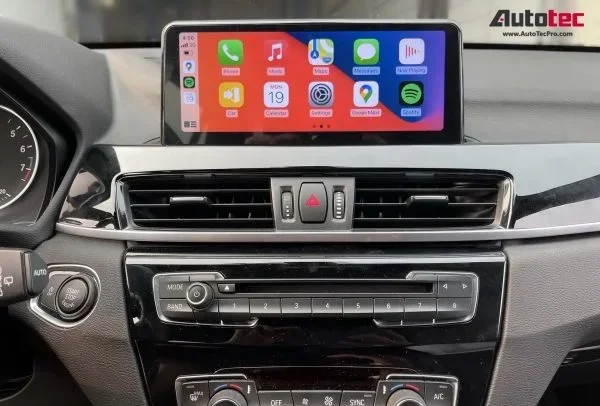
Featured image for BMW X1 navigation screen
Image source: autotecpro.com
How good is BMW naviation in X1 SUVs? The short answer: it is excellent for daily driving but has a learning curve. The standard iDrive 8 system offers crisp graphics, fast routing, and superb Head-Up Display integration. However, many owners still prefer wireless Apple CarPlay or Android Auto for familiar interfaces. We break down the pros, cons, and hidden features you need to know.
Buying a new compact luxury SUV is a big decision. You check the engine, the seats, and the cargo space. But today, the infotainment screen is the command center for your entire drive. If you are asking how good is BMW naviation in X1 models, you are asking the right question. The navigation system dictates how you find charging stations, avoid traffic jams, and navigate new cities. It needs to be fast, clear, and reliable.
The current generation X1 (U11 chassis) marked a massive tech leap. It switched to the BMW Operating System 9 running on the iconic Curved Display. This change moved almost every function onto glass. There are almost zero physical buttons left for climate or radio. For navigation, this means a bigger map view but a steeper learning curve. Let’s dive deep into what works, what annoys owners, and how it stacks up against using your phone.
Key Takeaways
- Standard iDrive 8: Every new X1 gets the latest OS with a massive curved display and natural voice control.
- Head-Up Display Sync: Turn-by-turn arrows project onto the windshield, keeping eyes on the road.
- Real-Time Traffic: BMW Maps handles congestion well, but requires a ConnectedDrive subscription after the trial.
- Wireless Phone Mirroring: CarPlay and Android Auto are standard and often preferred over native maps.
- Over-the-Air Updates: Map data and software refresh automatically via the built-in SIM card.
- Learning Curve: The touchscreen-heavy interface removes physical buttons, which frustrates some drivers initially.
- Offline Capability: Maps download regions for use in dead zones, a handy backup feature.
📑 Table of Contents
- The Heart of the System: iDrive 8 and OS 9
- Navigation Accuracy and Map Data: BMW Maps vs. Reality
- Smart Features That Make Daily Driving Easier
- Smartphone Integration: The CarPlay / Android Auto Factor
- Keeping It Fresh: Updates, Subscriptions, and Maintenance
- Common Quirks, Complaints, and Workarounds
- Comparison: X1 Nav vs. Key Rivals
- Is the Augmented Reality View Worth It?
- Tips to Master Your X1 Navigation Fast
- Expert Insight: The “Two-System” Strategy
- Conclusion
The Heart of the System: iDrive 8 and OS 9
The BMW X1 navigation experience lives or dies by the iDrive interface. The new X1 uses the eighth generation of iDrive paired with Operating System 9. This is the same tech found in the 7 Series and i7, just in a smaller package. It is a significant upgrade over the previous X1 (F48) which used iDrive 7.
A Screen That Dominates the Dash
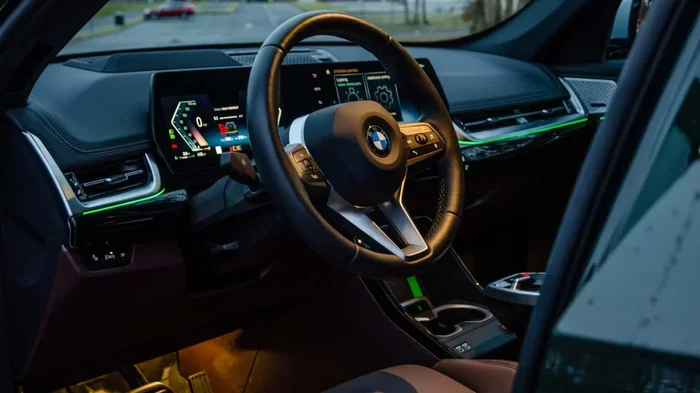
You cannot miss the BMW Curved Display. It merges a 10.25-inch instrument cluster with a 10.7-inch control display into one seamless glass arc. It leans toward the driver. For navigation, this is a win. The map renders with high resolution. Colors are vibrant. 3D buildings appear in major cities. Pinch-to-zoom works exactly like your smartphone. It feels modern because it basically is a giant tablet bolted to the dash.
Touch, Voice, or Rotary? The Input Debate
Here is the controversial part: BMW removed the iDrive rotary controller from the center console on the X1. You have three ways to control the nav now:
- Touchscreen: Primary method. Fast, intuitive for scrolling maps.
- Voice Assistant (“Hey BMW”): Excellent natural language processing. Say “I’m cold” and it raises temp. Say “Navigate to Starbucks” and it routes.
- Steering Wheel Buttons: Toggle through menus on the instrument cluster.
If you loved the rotary knob for its tactile feel without looking, you will miss it. Touchscreens demand visual attention. On a bumpy road, hitting a small “Avoid Toll” button is harder than twisting a knob. However, the voice assistant is genuinely good enough to handle 90% of destination entries without touching the screen.
Quick Split Screen: The Multitasking Hero
One feature that answers how good is BMW naviation in X1 positively is the “QuickSelect” tiles. You can pin a split-screen view. For example: Navigation map on the left, music source or phone contacts on the right. It stays persistent. You don’t need to swipe back and forth. It makes the wide aspect ratio of the curved display actually useful.
Navigation Accuracy and Map Data: BMW Maps vs. Reality
The native navigation engine is BMW Maps. It uses HERE Technologies data (formerly Navteq). This is a top-tier mapping provider used by many German brands. It is not Google Maps, but it is very competent.
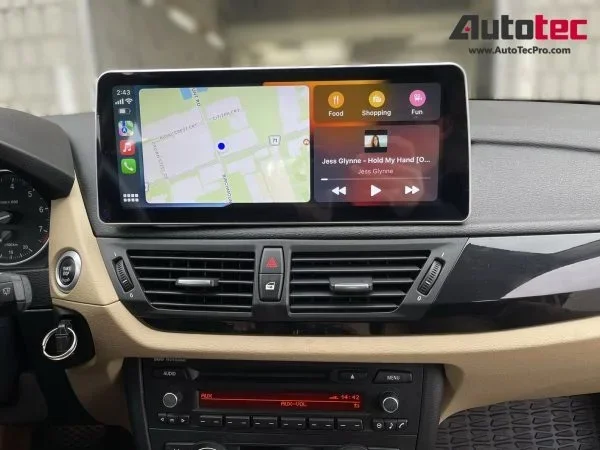
Visual guide about BMW X1 navigation screen
Image source: autotecpro.com
Real-Time Traffic Information (RTTI)
The system pulls live traffic flow via the car’s embedded 5G SIM (ConnectedDrive). It shows color-coded lines on highways: green, yellow, red, black. It calculates dynamic reroutes automatically. In testing, it reacts fast. If an accident pops up 5 miles ahead, the X1 often suggests a detour before you hit the backup. You get a pop-up: “Faster route found. Save 12 mins. Accept?” One tap on the screen or steering wheel confirms it.
Points of Interest (POI) Search
Searching for “EV charging,” “Coffee,” or “Parking” works well. The database is deep. It shows charger speeds (DC Fast vs Level 2), availability (if supported by the network), and pricing. For gas X1 models (sDrive28i / xDrive28i), it shows fuel prices at nearby stations. The “Smart Favorites” feature learns your habits. If you drive to work at 8 AM Monday-Friday, it auto-suggests the route with traffic on the home screen without you asking.
Lane Guidance and Junction View
On complex interchanges, the map switches to a photorealistic Junction View. It highlights the correct lane with an animated arrow. Simultaneously, the Head-Up Display (HUD) projects a simple arrow and distance countdown. This dual-screen guidance is where the factory nav beats phone mirrors. You keep eyes forward. The HUD is optional on base trims but standard on higher specs. Get it. It transforms the nav experience.
Smart Features That Make Daily Driving Easier
Beyond basic A-to-B routing, the X1 navigation packs “smart” features that justify the integrated approach.
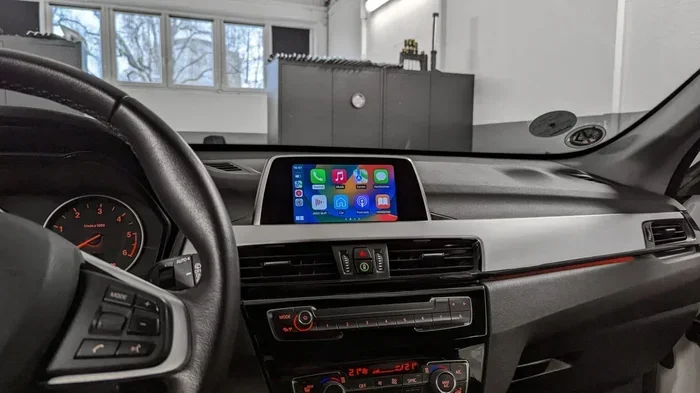
Visual guide about BMW X1 navigation screen
Image source: carhex.de
“Hey BMW” Natural Voice Control
This is the star of OS 9. You do not need rigid commands. Conversational input works.
- “Hey BMW, find a cheap Italian place nearby with outdoor seating.”
- “Hey BMW, avoid highways.”
- “Hey BMW, add a stop at the pharmacy on Main Street.”
It processes context. If you say “Navigate home,” it knows your saved home address. If you say “Navigate to Mom,” it checks your connected phone contacts (if permissions granted). It works offline for basic commands too, thanks to onboard processing.
Head-Up Display Integration
As mentioned, the HUD is a game changer. It projects speed, speed limit, and turn-by-turn arrows onto the windshield. The arrows scale with distance. A big arrow means “Turn now.” A tiny arrow means “Prepare to turn in 1 mile.” It works in bright sunlight (mostly) and at night. It reduces cognitive load significantly. You literally never need to glance at the center screen for a maneuver.
ConnectedDrive Store and Apps
The X1 has an app store. You can download Spotify, Amazon Music, Audible, and even video apps (video only plays when parked). For navigation, the “BMW Maps” app updates itself OTA. You don’t need to visit a dealer for map updates anymore. The car downloads delta updates in the background while parked on Wi-Fi or via the 5G modem.
Electric Range Routing (For X1 xDrive30e / iX1)
If you have the plug-in hybrid (xDrive30e) or the full electric iX1, the nav is smarter. Enter a destination beyond your battery range. The car calculates required charging stops. It picks specific chargers, estimates charge time needed to reach the next stop, and pre-conditions the battery (heats/cools it) as you approach the charger for max speed. This EV routing is superior to Apple Maps or Google Maps which often lack the car’s real-time battery thermal data.
Smartphone Integration: The CarPlay / Android Auto Factor
This is the elephant in the room. Many buyers ask how good is BMW naviation in X1 compared to just using Google Maps on CarPlay. The answer: The factory system is better integrated (HUD, instrument cluster, EV routing), but CarPlay is more familiar.
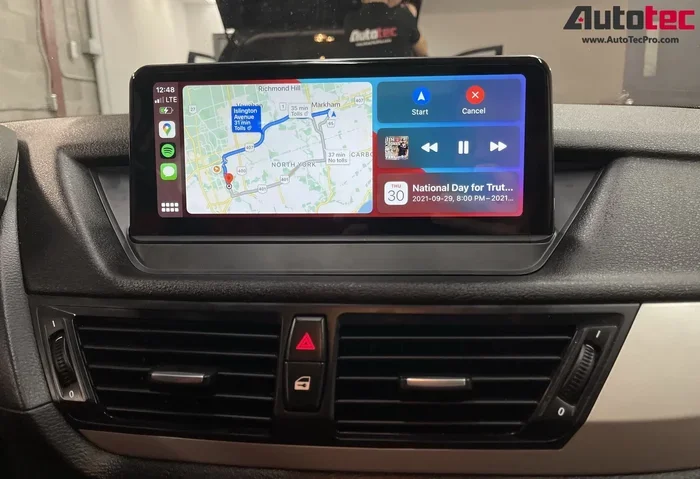
Visual guide about BMW X1 navigation screen
Image source: autotecpro.com
Wireless Standard Across the Board
Good news: Wireless Apple CarPlay and Wireless Android Auto are standard on every 2023+ X1. No cables. You get in, the car connects via Bluetooth/Wi-Fi handshake. Your phone screen mirrors to the curved display. You get Google Maps, Waze, Apple Maps, or TomTom Go on the big screen.
Why You Might Still Choose CarPlay
- Superior Search: Google’s POI database and “Search along route” are unmatched.
- Waze Community Alerts: Real-time police, pothole, and debris reports from users.
- Familiar UI: Zero learning curve. Muscle memory works instantly.
- Text/Call Handling: Siri/Google Assistant on the car mic is often more reliable for dictation than “Hey BMW.”
Why You Should Use Native BMW Maps
- HUD + Instrument Cluster: CarPlay maps do not show on the Head-Up Display or the driver’s instrument cluster behind the steering wheel. Only native nav does this.
- EV Battery Pre-conditioning: Only native nav talks to the battery management system to prep for fast charging.
- No Phone Battery Drain: Wireless CarPlay kills phone battery fast. Native nav uses the car’s power.
- Works Without Phone: If you forget your phone, or it dies, the car still navigates perfectly.
Pro Tip: Use native nav for long trips, EV routing, and highway driving (for HUD). Use CarPlay/Waze for urban commuting where police alerts and pothole warnings matter most.
Keeping It Fresh: Updates, Subscriptions, and Maintenance
A navigation system is only as good as its last update. BMW has modernized this significantly.
Over-the-Air (OTA) Map Updates
The X1 downloads map updates automatically. You park in your garage (Wi-Fi) or it uses the embedded 5G. You get a notification: “Map update available. Install now?” It installs while the car is off. No USB sticks. No dealer visits. This covers map geometry, new roads, and POI data. It happens quarterly usually.
The ConnectedDrive Subscription Trap
Here is the catch. Real-Time Traffic (RTTI), Connected Parking, Concierge Services, and the “Hey BMW” cloud-enhanced voice recognition require a ConnectedDrive subscription. New X1s come with a 3-year (sometimes 4-year) trial. After that, it costs roughly $100-$150/year depending on the package. If you let it lapse:
- Maps still work (offline data).
- Routing still works.
- You LOSE live traffic rerouting.
- You LOSE cloud voice processing (reverts to basic onboard only).
- You LOSE fuel price / EV charger availability updates.
Factor this cost into ownership. BMW service includes software checks, but map data subscriptions are separate.
Dealer Visits for Major OS Jumps
While maps update OTA, major Operating System jumps (e.g., OS 9 to OS 10) often require a dealer visit or a very long parked download session. These happen every 2-3 years. They bring new UI layouts, new apps, and kernel updates.
Common Quirks, Complaints, and Workarounds
No system is perfect. X1 forums (Bimmerpost, X1Forum, Reddit) highlight consistent friction points. Knowing them helps you decide if they are dealbreakers.
1. The “No Home Button” Muscle Memory Issue
There is no physical home button. You swipe up from the bottom bar or tap the BMW logo tile. New owners constantly hunt for it. Fix: Customize the “QuickSelect” bar at the bottom. Pin “Navigation,” “Phone,” “Media,” “Home” as permanent tiles. Then it acts like a home bar.
2. Screen Glare and Fingerprints
That gorgeous curved glass is a glare magnet at sunset. It also shows every fingerprint. Fix: A high-quality matte screen protector (like Brotect or Spigen) cuts glare 80% and hides prints. It makes the touch feel slightly paper-like but worth it.
3. Voice Assistant False Triggers
“Hey BMW” activates if passengers say “BMW” in conversation or if a podcast host says it. Fix: Adjust sensitivity in Settings > Voice Assistance > Activation Sensitivity. Or disable “Hey BMW” and use the steering wheel voice button only.
4. Slow GPS Lock After Battery Disconnect
If the car sits for weeks or the 12V battery is swapped, the GPS almanac clears. It can take 10-15 minutes of driving with clear sky to re-acquire satellites. Fix: Drive on an open highway for 15 mins after long storage. It fixes itself.
5. Route Preference Resets
Sometimes “Avoid Tolls” or “Avoid Ferries” toggles revert after a major software update. Fix: Check settings after any “Software Update Installed” notification.
Comparison: X1 Nav vs. Key Rivals
How does the X1 stack up against the Audi Q3, Mercedes GLA, and Volvo XC40?
| Feature | BMW X1 (iDrive 8/OS 9) | Audi Q3 (MMI Touch) | Mercedes GLA (MBUX) | Volvo XC40 (Google Built-in) |
|---|---|---|---|---|
| Screen Layout | Curved Dual Screen (Touch) | Dual Screen (Touch + Knob) | Dual Wide Screen (Touch) | Portrait Tablet (Touch) |
| Native Map Provider | HERE Technologies | HERE / TomTom | HERE / TomTom | Google Maps (Native) |
| HUD Nav Support | Yes (Excellent) | Yes (Good) | Yes (AR Optional) | Yes (Good) |
| Voice Assistant | “Hey BMW” (Cloud + Local) | “Hey Audi” (Basic) | “Hey Mercedes” (ChatGPT Integrated) | Google Assistant (Best-in-class) |
| Wireless CarPlay/Auto | Standard | Standard | Standard | Standard |
| EV Routing (PHEV/EV) | Excellent (Pre-conditioning) | Good | Good (Mercedes me Charge) | Excellent (Google EV Data) |
| Physical Controls | Minimal (Volume Knob Only) | Rotary Knob + Buttons | Touch Buttons on Wheel | Minimal (Steering Wheel) |
Verdict: The X1 wins on HUD integration and driver-focused screen angle. The Volvo XC40 wins on “just works” Google Maps native integration (no phone needed, ever). The Audi Q3 wins if you demand a rotary knob. The Mercedes GLA wins on “wow factor” screen size and ChatGPT voice.
Is the Augmented Reality View Worth It?
On higher trims (or as a standalone option on some markets), the X1 offers Augmented Reality (AR) Navigation. This uses the front camera to overlay a live video feed on the center screen (and sometimes HUD) with virtual arrows painted on the actual road.
- Pros: Incredibly intuitive at complex 5-way intersections. “Turn left at the red building” becomes visual.
- Cons: Only works on the center screen (not HUD usually). Consumes significant processing power. Can lag in low light or heavy rain. Often a paid option ($300-$500).
Most owners find the standard 3D Junction View + HUD arrows sufficient. AR is a “nice to have,” not a “must have.”
Tips to Master Your X1 Navigation Fast
Don’t learn this while driving. Spend 20 minutes parked in your driveway.
- Set Home/Work: Profile > Addresses. Enable “Commute Prediction.”
- Train Voice: Settings > Voice > Voice Training. Read the 5 phrases. It improves “Hey BMW” accuracy drastically.
- Pin QuickSelect Tiles: Long press any empty tile slot on the home bar. Add “Navigate Last Destination,” “EV Charging,” “Avoid Tolls Toggle.”
- Download Offline Maps: Navigation > Settings > Maps > Download Regions. Select your state/region. Essential for mountains/rural areas.
- Link BMW ID: Use the MyBMW App. Send destinations from phone to car (Send to Car). It syncs favorites bidirectionally.
- Calibrate HUD: If arrows seem misaligned, Settings > Displays > Head-Up Display > Calibration. Sit in your normal driving position.
Expert Insight: The “Two-System” Strategy
After 5,000 miles in a 2024 X1 xDrive28i, my strategy is simple. I run Native BMW Maps as the default. It runs on the instrument cluster and HUD. I run Wireless CarPlay in a split-screen tile (QuickSelect) for audio (Spotify/Podcasts) and Waze alerts. I swipe the CarPlay tile to full screen only when I need Waze’s police reports in the city. This gives me the best of both worlds: safety-critical info in my sightline (HUD), and crowd-sourced alerts on demand.
Conclusion
So, how good is BMW naviation in X1 models today? It is a top-tier system. The hardware (Curved Display, HUD, 5G modem) is flagship grade. The software (OS 9) is fluid, pretty, and smart. The integration with the car’s dynamics (EV pre-conditioning, cluster display, HUD) makes it safer and more convenient than a phone mount for highway driving.
The downsides are the touchscreen-only ergonomics (no rotary knob), the subscription cost for live services after the trial, and a POI search that still lags behind Google. But the gap is narrowing fast. If you buy an X1, spend the first week forcing yourself to use “Hey BMW” and the native maps. Learn the split-screen. Set up the offline maps. You will likely find you rarely need to plug in a cable or mirror your phone. The car has finally become the best computer in your pocket.
Ready to hit the road? Pair your phone, say “Hey BMW, navigate to [your favorite road],” and enjoy the drive. The tech is finally good enough to disappear into the background—which is exactly where it belongs.
Frequently Asked Questions
Does the BMW X1 have built-in navigation standard?
Yes, every 2023 and newer BMW X1 (U11 chassis) comes standard with the BMW Curved Display, iDrive 8, and native BMW Maps navigation. You do not need to option a “Navigation Package” anymore; it is baked into the Operating System 9.
Can I use Google Maps or Waze on the BMW X1 screen?
Absolutely. The X1 features standard wireless Apple CarPlay and wireless Android Auto. You can run Google Maps, Waze, or Apple Maps full-screen on the 10.7-inch center display. However, these apps will not project directions onto the Head-Up Display or the driver’s instrument cluster.
Do I have to pay a subscription for BMW navigation to work?
The base maps and routing work forever with no subscription. However, Real-Time Traffic Information (RTTI), live fuel/EV charger prices, cloud-based voice recognition, and map updates over the cellular network require an active ConnectedDrive subscription after the initial 3-4 year trial expires.
How do I update maps on the BMW X1?
Map updates happen automatically Over-the-Air (OTA). The car uses its built-in 5G modem or your home Wi-Fi to download updates in the background while parked. You simply accept the install prompt on the screen. No USB drives or dealer visits are required for standard map refreshes.
Is the BMW X1 Head-Up Display worth it for navigation?
Yes, it is one of the best features. The HUD projects turn-by-turn arrows, distance countdowns, and lane guidance directly onto the windshield in your line of sight. This allows you to navigate complex interchanges without ever glancing at the center screen, significantly reducing distraction.
Why does my BMW X1 navigation lose GPS signal sometimes?
If the car has been parked for a long time (weeks) or the 12V battery was disconnected/replaced, the GPS almanac data is lost. It requires 10–15 minutes of driving with a clear view of the sky to re-download satellite ephemeris data and regain a fast lock. This is normal behavior for all GNSS receivers.