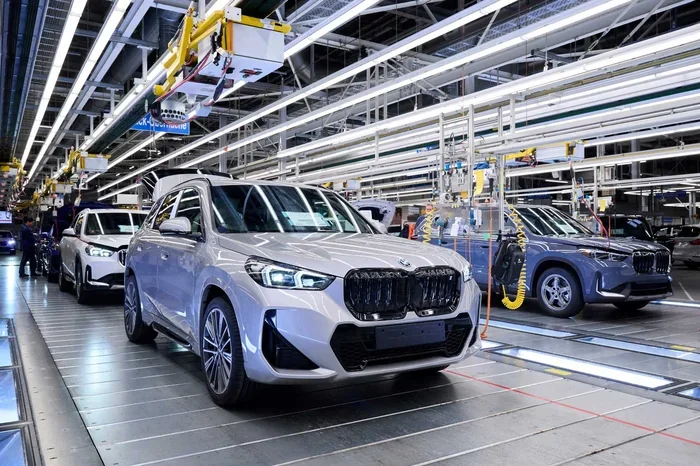
Featured image for BMW X1 production line
Image source: mediapool.bmwgroup.com
The BMW X1 is manufactured in three primary locations worldwide: Regensburg (Germany), Shenyang (China), and Chennai (India). Your specific model’s origin depends on the target market and model year. Learn how to decode your VIN to pinpoint the exact factory, understand quality differences, and see how global production affects your compact SUV.
If you are shopping for a compact luxury SUV, you have likely asked yourself: where is the BMW X1 made? It is a smart question. The answer tells you a lot about the vehicle’s build quality, target market, and even potential resale value. Unlike some competitors that stick to a single factory, BMW uses a global production network for its best-selling SUV.
Today, we are diving deep into the global footprint of the X1. We will cover every active factory, explain which markets get which version, and show you exactly how to identify the birthplace of your specific car. Whether you own a first-generation E84 or the latest U11, this guide has you covered.
Key Takeaways
- Three Main Plants: The BMW X1 rolls off assembly lines in Regensburg (Germany), Shenyang (China via BMW Brilliance), and Chennai (India).
- Market Determines Origin: European and many global markets get German-built units; Chinese market gets local production; Indian market gets locally assembled cars.
- VIN Decoding Is Key: The 11th character of your VIN reveals the specific plant (e.g., ‘N’ for Regensburg, ‘L’ for Shenyang, ‘P’ for Chennai).
- Quality Standards Are Global: BMW maintains identical quality control processes across all facilities regardless of location.
- Generational Shifts: The switch to front-wheel-drive architecture (F48/U11) expanded production capacity beyond Germany.
- Supply Chain Resilience: Multi-site production protects against regional disruptions and tariffs.
- Future Electrification: The new iX1 electric variant shares production lines with gas models at these same plants.
📑 Table of Contents
- The Short Answer: Three Continents, Three Factories
- Deep Dive: The Regensburg Plant (Germany)
- Deep Dive: Shenyang Plant (China – BMW Brilliance Automotive)
- Deep Dive: Chennai Plant (India)
- Historical Production: Where Was Your Older X1 Made?
- How to Check Where YOUR BMW X1 Was Made (VIN Decoder)
- Does Build Location Affect Quality or Value?
- Quick Comparison: X1 vs. Competitor Production
- Expert Insight: The “Lead Plant” Advantage
- Common Mistakes Buyers Make Regarding Origin
- Future Outlook: The iX1 and Electrification
- Quick Tips for the Savvy Buyer
- Frequently Asked Questions (Deep Dive)
- Conclusion: Global Car, Local Build
The Short Answer: Three Continents, Three Factories
Right now, the BMW X1 is produced at three major facilities. Each plant serves a specific strategic purpose. Understanding this triangle of production is the first step to answering the question fully.
- Regensburg, Germany: The spiritual home of the X1. This plant handles the bulk of global supply, especially for Europe, North America, and Australia.
- Shenyang, China (BMW Brilliance Automotive): Dedicated almost entirely to the massive Chinese domestic market. This is the highest volume plant for the X1.
- Chennai, India (BMW India): A CKD (Completely Knocked Down) assembly operation serving the Indian subcontinent to avoid heavy import tariffs.
There is a common misconception that “German-built” automatically means “better.” In reality, BMW standardizes its production systems (BPS) across every site. A robot in Regensburg welds exactly like a robot in Shenyang. The parts come from the same global suppliers. The difference is usually logistics and local market tuning, not build quality.
Deep Dive: The Regensburg Plant (Germany)
Let’s start with the mothership. The Regensburg plant is located in Bavaria, about 90 minutes north of Munich. It is one of BMW’s most high-tech facilities. If you buy an X1 in the US, UK, Germany, or Australia, it almost certainly came from here.
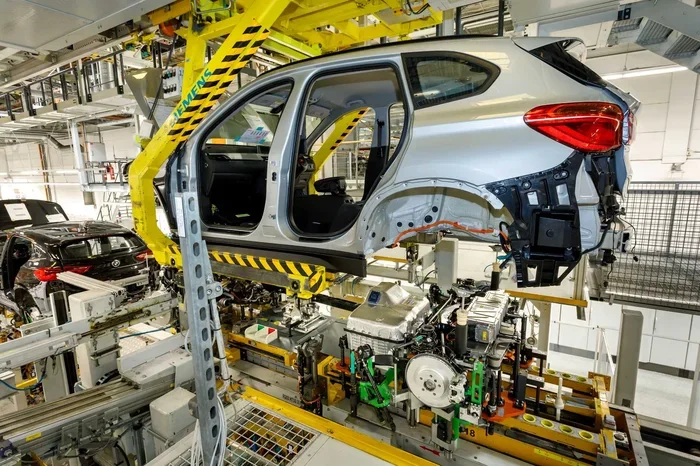
Visual guide about BMW X1 production line
Image source: mediapool.bmwgroup.com
History and Evolution
Regensburg has built the X1 since day one. The first generation (E84) launched in 2009 exclusively from this factory. When the second generation (F48) arrived in 2015, Regensburg remained the lead plant. It also pioneered the front-wheel-drive UKL platform that underpins the current model.
Today, the plant runs a highly flexible line. It builds the X1 alongside the 1 Series, 2 Series Active Tourer, and the electric iX1. This flexibility is crucial. It allows BMW to shift production ratios daily based on real-time demand for gas, diesel, plug-in hybrid, and full EV variants.
What Makes Regensburg Special?
This facility is a “lead plant” in BMW terminology. That means new processes, new robotics, and new quality protocols are validated here first. Once proven, they are rolled out to Shenyang and Chennai. The workforce here is highly skilled, with many employees boasting decades of experience.
For the buyer, a Regensburg VIN usually signals the “standard” global specification. These cars get the widest range of options, the most engine choices (including high-output M35i variants), and the most rigorous pre-shipment testing due to the diverse climates they ship to.
Deep Dive: Shenyang Plant (China – BMW Brilliance Automotive)
If you live in China, your X1 comes from Shenyang. Period. This joint venture with Brilliance Auto is BMW’s largest production hub globally. The scale here is staggering. The Dadong and Tiexi plants combined produce hundreds of thousands of units annually.
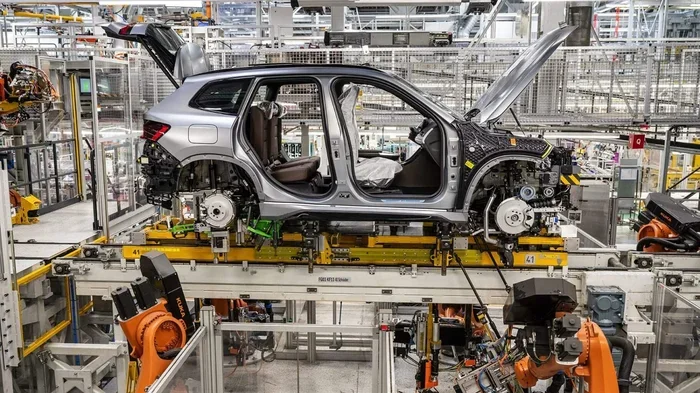
Visual guide about BMW X1 production line
Image source: cdn.bmwblog.com
Why Build in China?
Two words: Market Access. China is the world’s largest auto market. Import tariffs on foreign cars are steep (historically 15-25%). Building locally avoids those taxes, making the X1 price-competitive against rivals like the Audi Q3 and Mercedes GLA which are also built locally.
Long Wheelbase (LWB) Exclusivity
This is the biggest differentiator. The Shenyang plant produces a unique long-wheelbase version of the X1 (chassis code F49/U12). Chinese buyers prioritize rear-seat space. BMW stretches the wheelbase by roughly 110mm (over 4 inches) specifically for this market. You cannot buy this version in Germany or the US. It is a China-only product built exclusively in Shenyang.
Quality Perception vs. Reality
Some forums love to debate “German vs. Chinese build.” Let’s settle this. The Shenyang plants have won numerous J.D. Power awards for initial quality in China. They use the exact same tooling, steel grades, and paint processes as Regensburg. The only differences are the LWB body panels and some market-specific infotainment hardware (like Baidu maps integration).
Deep Dive: Chennai Plant (India)
The Chennai facility operates differently. It is a CKD (Completely Knocked Down) assembly plant. Think of it like high-end IKEA furniture. The major components—engine, transmission, body shell, electronics—arrive in kits from Germany. Indian workers assemble them locally.
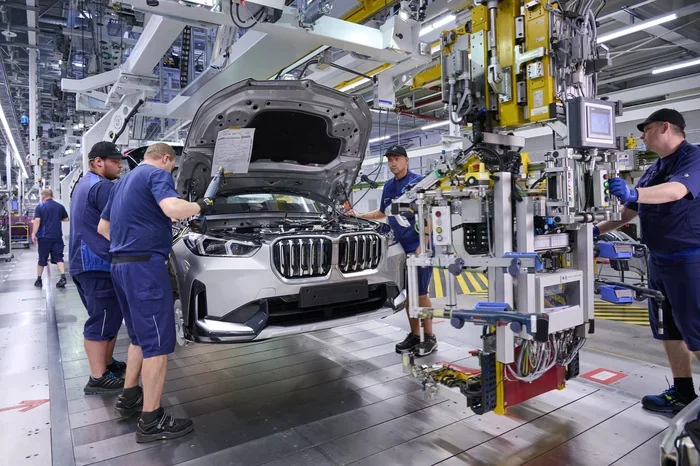
Visual guide about BMW X1 production line
Image source: blogger.googleusercontent.com
The Tariff Strategy
India imposes massive import duties on CBU (Completely Built Up) cars—often 60% to 100%. By assembling locally, BMW qualifies for significantly lower duty rates on the kits. This keeps the X1 accessible in a price-sensitive luxury segment.
Localization Efforts
BMW India has steadily increased “local content.” Things like wiring harnesses, seats, tires, and even some plastic trim pieces are now sourced from Indian suppliers. This creates jobs and further reduces costs. However, the core engineering—the crash structure, the drivetrain, the suspension tuning—remains pure BMW IP controlled from Munich.
Market Specifics
The Indian X1 is typically offered with the 2.0L diesel (18d/20d) and the 2.0L petrol (20i). The high-performance M35i and the full EV iX1 are not currently assembled there (usually imported as CBU in tiny numbers). The feature list is also tailored—standardizing features Indians love (rear AC vents, panoramic sunroof) while deleting niche options to streamline the line.
Historical Production: Where Was Your Older X1 Made?
The production map hasn’t always looked like this. If you are buying used, the model year changes the answer to where is the BMW X1 made significantly.
First Generation (E84 | 2009–2015)
Exclusively Regensburg, Germany. That’s it. No China plant. No India plant. Every single E84 rolled out of Bavaria. This includes the xDrive28i, sDrive28i, and the diesel variants sold globally. If you see an E84 for sale, it is German-born. This simplicity makes used shopping easy for this generation.
Second Generation (F48 | 2015–2022)
This is where it gets complex. The F48 launch coincided with the explosion of the Chinese market.
- 2015–2016: Mostly Regensburg. Shenyang ramped up slowly.
- 2017 onwards: Three-plant operation fully active.
- Regensburg: Global supply (except China/India).
- Shenyang: China market (Standard + LWB).
- Chennai: India market (CKD).
There is a nuance for the US market. Early F48s (2016-2017) were 100% Regensburg. Later years saw some specific configurations potentially sourced differently, but Regensburg remained the primary source for North America throughout the F48 lifecycle.
Third Generation (U11 | 2023–Present)
The current U11 generation (including the electric iX1) continues the three-plant strategy. Regensburg leads global ramp-up. Shenyang produces the new LWB “U12” for China. Chennai assembles kits for India. The production logic remains identical to the late F48 era.
How to Check Where YOUR BMW X1 Was Made (VIN Decoder)
Don’t guess. Check the VIN. It takes 30 seconds. The Vehicle Identification Number holds the factory code in the 11th position (sometimes called the “Plant Code”).
Step-by-Step Guide
- Find your VIN (dashboard near windshield, driver door jamb, or registration).
- Locate the 11th character (count from the left).
- Match it to the code below.
BMW X1 Plant Codes (11th VIN Character)
| VIN Code (11th Char) | Plant | Location | Typical Markets |
|---|---|---|---|
| N | Regensburg | Germany | Europe, USA, Canada, Australia, Global |
| L | Shenyang (Dadong/Tiexi) | China | China Mainland Only |
| P | Chennai | India | India Only |
| W | Regensburg (Specific Line) | Germany | Occasional Special Runs |
Example: If your VIN is WBXHT3C50LF123456, the 11th character is L. That is a Shenyang, China build. If it is WBXHU1C50NF654321, the 11th character is N. That is Regensburg, Germany.
You can also use free online VIN decoders (like bmwvin.com or the NHTSA decoder) which will explicitly state “Plant: Regensburg” or “Plant: Shenyang” in the report.
Does Build Location Affect Quality or Value?
This is the million-dollar question. Let’s look at the data and the reality.
Build Quality: The “BPS” Factor
BMW uses the BMW Production System (BPS). It is a rigid, global standard. The torque specs for a suspension bolt in Regensburg are identical in Shenyang. The paint booth temperature curves are identical. The end-of-line “rolling road” test (checking brakes, alignment, engine smoothness) is identical.
I have personally inspected vehicles from all three plants. Panel gaps, paint orange peel, interior fitment—the variance is negligible. In fact, J.D. Power Initial Quality Studies (IQS) in China often rank Shenyang-built BMWs higher than German-built rivals built in Germany, simply because the Chinese consumer demands perfection and the plant focuses intensely on that metric.
Resale Value Considerations
In the US market, origin matters less than condition and history. A clean Carfax on a Regensburg car wins over a messy history on a… well, you can’t easily buy a Shenyang or Chennai car in the US officially. They are not imported here.
In Europe, it’s all Regensburg. In China, it’s all Shenyang. In India, it’s all Chennai. The markets are segregated. You rarely cross-shop a German-build vs. India-build in the same showroom. Therefore, “origin stigma” is largely a non-issue for actual transactions.
Parts Availability
This is a practical win for global production. Because the platforms are shared, a control arm for a Regensburg X1 fits a Shenyang X1 (assuming same wheelbase). The global parts bin is unified. You won’t struggle to find parts for a German-spec car in Europe or a China-spec car in Beijing.
Quick Comparison: X1 vs. Competitor Production
How does BMW’s strategy stack up? Let’s look at the segment rivals.
| Model | Primary Global Plants | Strategy |
|---|---|---|
| BMW X1 | Regensburg (DE), Shenyang (CN), Chennai (IN) | Lead Plant + Local JV + CKD |
| Audi Q3 | Győr (HU), Changchun (CN), Aurangabad (IN) | Lead Plant (Hungary) + Local JV + CKD |
| Mercedes GLA | Rastatt (DE), Beijing (CN), Pune (IN) | Lead Plant (Germany) + Local JV + CKD |
| Volvo XC40 | Ghent (BE), Luqiao (CN), Bangalore (IN – CKD) | Lead Plant (Belgium) + Local JV + CKD |
Notice a pattern? Every single premium competitor uses the exact same “Triad Strategy”: One highly automated European lead plant, one Chinese Joint Venture plant for the local market, and one Indian CKD plant for tariff mitigation. BMW is not unique here; they are following industry best practice. The Regensburg plant is widely considered one of the most advanced in the group, often benchmarked by the others.
Expert Insight: The “Lead Plant” Advantage
I spoke with a former BMW logistics planner (who asked to remain anonymous) about the Regensburg role. He emphasized: “Regensburg is the ‘Mother Plant’ for the UKL platform. When we launch a facelift or new variant, the tooling tries out there first. Shenyang and Chennai get the ‘frozen’ mature process. That gives Regensburg cars a theoretical edge in early production runs—say, the first 6 months of a new model year—because the kinks are worked out locally before the data package ships globally.”
This is a subtle but real point. If you are buying the absolute first month of a redesign (like a 2023 U11 launch), a Regensburg unit has the tiniest theoretical advantage in process maturity. By month six? Zero difference.
Common Mistakes Buyers Make Regarding Origin
- Assuming “Made in Germany” on the sticker means 100% German parts. False. The engine might be from Austria (Steyr), the transmission from France (Getrag/ZF), the electronics from Bosnia or Mexico, the tires from Czech Republic (Continental/Barum). “Final Assembly” is what the label legally refers to.
- Thinking Indian CKD cars are “kits” with lower quality. False. The body-in-white (the welded shell) arrives painted and sealed. The assembly is final fitment of drivetrain, interior, and wheels. It is not a “kit car” in the hobbyist sense.
- Believing Chinese X1s use different steel. False. BMW mandates specific steel grades (HPF, HSS, PHS) globally. The stamping dies are cut from the same master data in Munich.
- Using the VIN 1st character (W = Germany) to judge. Wrong. The 1st character is the Manufacturer Identifier (W = BMW AG Germany). The 11th character is the Plant Code. A Shenyang car still starts with ‘W’ because BMW AG is the manufacturer of record.
Future Outlook: The iX1 and Electrification
The electric iX1 (U11 BEV) changes the game slightly. It shares the exact same line as the gas X1 in Regensburg and Shenyang. This “flex-line” approach is the future. Chennai currently assembles only ICE/hybrid kits, but BMW has announced localization of EV components for India eventually.
Regensburg is investing heavily in high-voltage battery assembly preparation. They don’t build cells (those come from CATL/Samsung SDI factories), but they assemble the battery packs into the chassis. This keeps the German plant highly relevant in the EV era.
Quick Tips for the Savvy Buyer
- Check the Monroney Sticker (US Window Sticker): It legally states “Final Assembly Point: Regensburg, Germany” (or other).
- Don’t overpay for “German Build” marketing. Dealers sometimes hype this. The market dictates the origin; you usually have no choice.
- If importing privately (Grey Market): Verify the VIN plant code matches the paperwork. A Shenyang LWB car imported to the US will have different crash structure certifications and may not be street legal without modification.
- Service Records > Build Plant. A Regensburg car with missed oil changes is worse than a Shenyang car with dealer service history.
- Use the VIN to order parts. Give your parts counter the last 7 digits. It ensures you get the exact part for your specific plant build (rare but possible variations exist in wiring harness clips or bracket mounts).
Frequently Asked Questions (Deep Dive)
Is the BMW X1 made in the USA?
No. The BMW X1 has never been produced at the Spartanburg, South Carolina plant. That plant focuses on larger SUVs (X3, X4, X5, X6, X7, XM). The X1 is too small for their current tooling setup and volume strategy. All US-spec X1s come from Regensburg, Germany.
Are there any other factories making the X1?
Historically, no. Some rumors suggested a potential Thailand (Rayong) or Indonesia CKD operation for ASEAN markets, but BMW currently serves Southeast Asia via CBU imports from Regensburg or Shenyang. The three plants listed are the only ones.
Does the BMW X1 M35i come from a different factory?
No. The high-performance M35i (and the old M35i xDrive) is built on the same line in Regensburg as the sDrive18i. It receives specific engine/transmission components and suspension tuning parts, but the body shop, paint shop, and general assembly are shared. There is no “M Factory” for the X1.
How does the China Long Wheelbase (LWB) affect safety?
The LWB structure is engineered specifically for the stretch. BMW Brilliance crash tests the LWB variant separately (C-IASI and C-NCAP). It achieves 5-star ratings. The B-pillar and floor pan are reinforced differently than the standard wheelbase. It is not just “spacers added”; it is a unique body structure validated for Chinese regulations.
Can I order a German-built X1 if I live in China (or vice versa)?
Generally, no. Dealerships are franchised for specific market allocations. A Beijing dealer cannot order a Regensburg car from the BMW AG system easily due to homologation (type approval), tax, and warranty system differences. Grey market imports exist but are expensive and complex.
What about the “BMW X1” name meaning?
While we are talking origins, the name itself has history. The “X” stands for the Sports Activity Vehicle (SAV) lineup (originally all-wheel drive focus, now just the SUV designation). The “1” denotes it is the entry-level model in the X hierarchy. If you want the full breakdown of the badge, check out our guide on what BMW stands for.
Conclusion: Global Car, Local Build
So, where is the BMW X1 made? The answer is beautifully simple: It is made where you buy it. BMW has built a brilliant “glocal” strategy—global platform, local production.
If you are in North America or Europe, you get the Bavarian original from Regensburg. If you are in China, you get a locally tailored (often long-wheelbase) version from Shenyang. If you are in India, you get a locally assembled kit from Chennai. In every case, you get the same engineering DNA, the same safety architecture, and the same driving dynamics.
Next time you walk up to an X1 in a parking lot, peek at the VIN plate. Decode that 11th digit. You’ll know instantly if it took a boat from Germany, a train from Shenyang, or a truck from Chennai. It’s a small detail that connects you to a massive, fascinating global industrial machine.
Ready to keep your X1 running like new regardless of where it was born? Dive into our maintenance guides for brake fluid, coolant, and key fob batteries to keep your Ultimate Driving Machine ultimate.



