Featured image for BMW X1 badge close up
Image source: images.caricos.com
How can I tell what kind of X1 I have? This comprehensive guide walks you through every method to identify your exact BMW X1 model, from VIN decoding and generation spotting to understanding trim badges and option codes. You will learn the quickest ways to pinpoint your specific vehicle for accurate parts ordering, maintenance scheduling, and resale value.
You walk out to your driveway, look at your BMW X1, and a simple question pops into your head: how can I tell what kind of X1 I have? It sounds like it should be easy. You bought the car, after all. But then you look at the badge on the trunk. It says “xDrive20i” or maybe “sDrive18d” or just “X1”. What does that actually mean? Is it the first generation or the second? Does it have the M Sport package? What engine is actually under the hood?
You are not alone. BMW naming conventions are famously complex. They have changed significantly over the years. The X1 has spanned three completely different platform generations. Each generation brought new engines, new tech, and new naming rules. Knowing your exact model is critical. It ensures you buy the right parts. It helps you schedule the correct maintenance. It determines your insurance rate and resale value. This guide will turn you into an X1 identification expert. We will cover VIN decoding, visual generation spotting, badge translation, and option code reading.
Key Takeaways
- VIN decoding is the gold standard: Your 17-character VIN reveals the exact factory specifications, engine, drivetrain, and options.
- Three distinct generations exist: The E84 (2009-2015), F48 (2015-2022), and U11 (2023-present) have clear visual and mechanical differences.
- Badging tells the drivetrain story: “sDrive” means front-wheel drive (or RWD on old models), while “xDrive” indicates all-wheel drive.
- Engine badges changed over time: Numbers like 18i, 20i, 25i, 28i, and M35i correspond to specific engine outputs and generations.
- Option codes unlock hidden features: The sticker in your door jamb or trunk lists 3-digit codes for every factory-installed option.
- M Sport is an appearance package: It adds aerodynamic bodywork, suspension tweaks, and interior trim but does not change the engine.
- Build sheets provide the full history: Requesting a build sheet from BMW gives you the original window sticker and complete option list.
📑 Table of Contents
- Why Knowing Your Exact X1 Model Matters
- The Quickest Way: Decode Your VIN
- Identifying Your X1 Generation at a Glance
- Breaking Down Trim Levels and Drivetrains
- Using BMW Option Codes and Build Sheets
- Quick Reference: X1 Model Year Changes
- Physical Inspection Checklist: 5-Minute Walkaround
- Common Mistakes to Avoid
- Expert Insights: The “Hidden” Identifiers
- Key Takeaways
- Conclusion
Why Knowing Your Exact X1 Model Matters
You might wonder why you need to go beyond “I have a blue X1.” The difference between an X1 sDrive18i and an X1 xDrive25i is massive. One is a front-wheel-drive economy model with a 1.5-liter three-cylinder. The other is an all-wheel-drive performance model with a 2.0-liter four-cylinder. If you order brake pads for the wrong one, they will not fit. If you use the wrong oil spec, you risk engine damage. If you sell the car and advertise it incorrectly, buyers will lose trust.
Service and Maintenance Accuracy
BMW maintenance schedules are tied to specific engine codes and chassis codes. An N20 engine (found in early F48 20i/28i models) has a timing chain service interval that differs from the B48 engine that replaced it. The B38 three-cylinder in the 18i has a different oil capacity than the B47 diesel. Guessing leads to missed services or wasted money.
Parts Compatibility
Body panels, suspension components, and electronic modules are generation-specific. An F48 front bumper will not fit a U11. An E84 control arm will not fit an F48. Even within a generation, xDrive models have different drivetrain components than sDrive models. Precision saves you return shipping fees and downtime.
Resale Value and Insurance
Insurance companies rate vehicles by specific model codes. An M35i costs significantly more to insure than an sDrive18i. When selling, buyers search for specific trims. “2019 BMW X1” gets fewer clicks than “2019 BMW X1 xDrive20i M Sport with Premium Package.” Accuracy commands a higher price.
The Quickest Way: Decode Your VIN
The Vehicle Identification Number (VIN) is your car’s fingerprint. It is a 17-character code that tells you everything. It reveals the factory, the model year, the engine, the transmission, the restraint system, and the sequential production number. This is the single most accurate answer to how can I tell what kind of X1 I have.
Visual guide about BMW X1 badge close up
Image source: c8.alamy.com
Where to Find Your VIN
You can find the VIN in three primary spots:
- Dashboard: Look through the windshield on the driver’s side corner. It is etched on a metal plate.
- Driver’s Door Jamb: Open the driver’s door. Look at the sticker on the B-pillar (the pillar between front and rear doors).
- Registration and Insurance: Your paperwork always lists the VIN.
Pro tip: Take a photo of the dashboard VIN with your phone. Save it in a notes app. You will need it for parts orders, service appointments, and insurance quotes.
Using Online VIN Decoders
Do not try to memorize the VIN structure. Use a free decoder. The best free tools are:
- BMW VIN Decoder (bmwvin.com or similar): These sites are built specifically for BMW coding. They break down every option code.
- NHTSA VIN Decoder: The government database for safety recalls and basic specs.
- RealOEM.com: This is the enthusiast gold standard. Enter your VIN, and it shows you every exploded parts diagram for your specific car.
Simply type in the 17 digits. The report will list: Model (e.g., F48), Sales Designation (e.g., X1 xDrive20i), Engine (e.g., B48B20A), Transmission, Production Date, Paint Code, Upholstery Code, and a full list of Option Codes (SA codes).
Understanding the VIN Structure Basics
While decoders do the work, understanding the first few characters helps you verify the report instantly.
- Positions 1-3 (WMI): WBA or WBX = BMW Passenger Car / SUV built in Germany. 5UX or 5YM = Built in USA (Spartanburg) or Mexico. Most X1s are German (Regensburg) or Chinese (Dadong for local market), but F48s for the US market were built in Regensburg. U11s are built in Regensburg and China.
- Position 4-8 (VDS): Describes the vehicle attributes. Series, body style, engine, restraint system.
- Position 9: Check digit (math validation).
- Position 10: Model Year. L=2020, M=2021, N=2022, P=2023, R=2024, S=2025.
- Position 11: Plant Code.
- Position 12-17: Sequential Production Number.
Identifying Your X1 Generation at a Glance
Before you even decode the VIN, you can identify the generation by looking at the car. The X1 has three distinct generations. They look radically different. This is the fastest way to narrow things down.
Visual guide about BMW X1 badge close up
Image source: c8.alamy.com
First Generation (E84) — 2009 to 2015
The original X1. It looks like a jacked-up 3 Series wagon. It sits on the rear-wheel-drive platform (shared with E90/E91 3 Series).
Key Visual Cues:
- Kidney Grille: Tall, narrow, vertical slats. Distinct gap between the two kidneys.
- Headlights: Rounded rectangular shape. “Angel Eyes” (halo rings) on higher trims. No LED daytime running lights on early models (pre-LCI).
- Roofline: More upright, boxy greenhouse. Tall windows.
- Tail Lights: Vertical orientation, wrap slightly onto the tailgate. Distinct “L” shape on later models.
- Badge Location: Model badge on the right side of the tailgate.
- Drivetrain Layout: Longitudinal engine. sDrive = Rear Wheel Drive (RWD). xDrive = All Wheel Drive.
Engines: N20 (2.0T 4-cyl), N52 (3.0L NA 6-cyl on xDrive28i early), N47/N57 (Diesels).
LCI (Life Cycle Impulse) 2013+: Updated bumpers, LED tail lights, new engines (N20 replaces N52), 8-speed auto replaces 6-speed.
Second Generation (F48) — 2015 to 2022
A complete reinvention. Switched to front-wheel-drive platform (UKL2 architecture, shared with Mini Countryman, 2 Series Active Tourer). Wider, longer, lower, roomier inside.
Key Visual Cues:
- Kidney Grille: Wider, lower, hexagonal-ish shape. The two kidneys almost touch in the middle (connected by a thin bar on M Sport).
- Headlights: Sharper, more angular. LED DRLs standard on later models (distinct “eyebrow” or “hockey stick” shape). Adaptive LED optional.
- Body Creases: Strong “character line” running from headlight to tail light. Hofmeister kink at C-pillar is sharper.
- Tail Lights: Horizontal, sleek, LED signature (two horizontal bars). Very wide stance.
- Badge Location: Centered on tailgate (early) or right side (later).
- Drivetrain Layout: Transverse engine. sDrive = Front Wheel Drive (FWD). xDrive = AWD (Haldex-based).
Engines: B38 (1.5T 3-cyl), B48 (2.0T 4-cyl), B47 (2.0D 4-cyl). All modular BMW engines.
LCI 2019+ (2020 Model Year): Larger kidneys (controversial), new LED headlight design (single barrel low beam), updated iDrive 7.0 with touchscreen, new steering wheel, 48V mild hybrid on some engines.
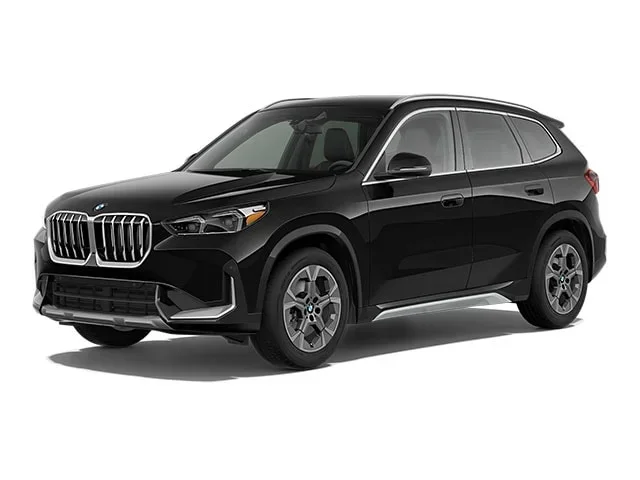
Third Generation (U11) — 2023 to Present
The current model. Evolution of F48 but on updated FAAR platform. Also includes the electric iX1 (U12).
Key Visual Cues:
- Kidney Grille: Massive. Nearly touches the bottom bumper. Optional “Iconic Glow” illuminated surround.
- Headlights: Very slim. Arrow-shaped DRLs (standard LED) or Laserlight (optional). No “angel eyes” anymore.
- Profile: More muscular shoulders. Flush door handles. Hofmeister kink is now a sharp crease in the window surround.
- Tail Lights: Full-width light bar look (distinct 3D L-shape units). Very modern.
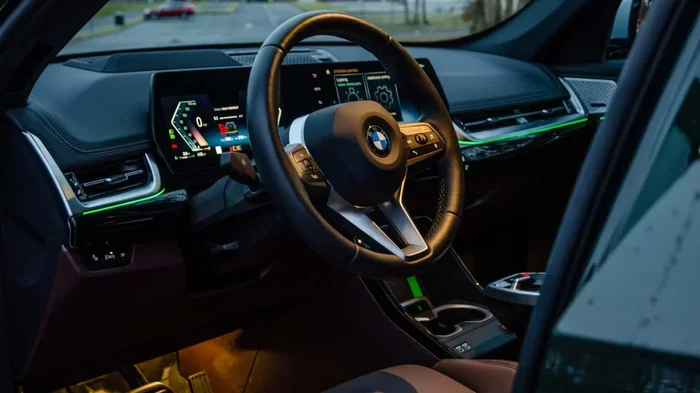
- Interior: Curved Display (dual 10.25″ + 10.7″ screens). No physical iDrive controller. Toggle gear selector. Vegan leather standard.
- Badging: New logic. “xDrive20i”, “xDrive23i”, “M35i xDrive”. No more “sDrive” on gas models in US (all AWD). Diesel retains sDrive/xDrive in Europe.
Engines: B48 2.0T (various tunes), B47 2.0D. M35i gets 312 hp. iX1 xDrive30 is dual-motor electric.
Visual Differences Between Generations: Quick Comparison Table
| Feature | E84 (Gen 1) | F48 (Gen 2) | U11 (Gen 3) |
|---|---|---|---|
| Platform | RWD-based (Longitudinal) | FWD-based (Transverse) | FWD-based (FAAR) |
| Grille Shape | Tall, Vertical, Separated | Wide, Hexagonal, Connected | Huge, Vertical, Dominant |
| Headlight DRL | Round Halos (Angel Eyes) | Hockey Stick / Eyebrow LED | Sharp Arrow / Laser |
| sDrive Means | RWD | FWD | FWD (EU Diesel only) |
| Interior Screen | Standalone Monitor (CIC/NBT) | Standalone -> Touchscreen (LCI) | Curved Dual Screen |
| Shifter | Traditional Lever | Traditional -> Toggle (LCI) | Toggle Switch |
Breaking Down Trim Levels and Drivetrains
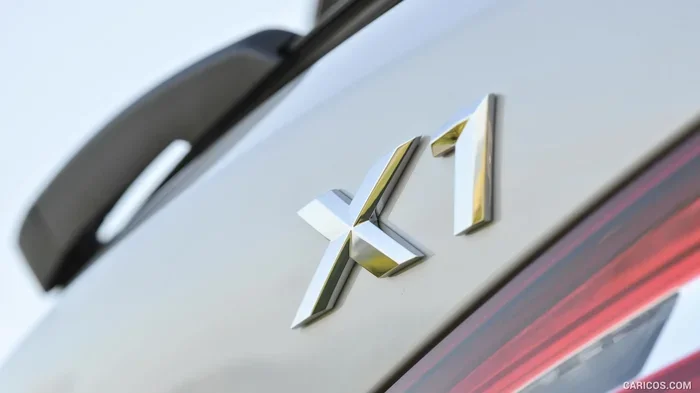
Once you know the generation, the badge on the back tells you the trim and drivetrain. BMW badge logic follows a pattern: Model + Drivetrain + Engine/Performance.
Visual guide about BMW X1 badge close up
Image source: images.caricos.com
sDrive vs xDrive Explained
This is the most important distinction.
- sDrive: Two-wheel drive.
- E84 (Gen 1): Rear-Wheel Drive. Sporty balance, poor snow traction without winter tires.
- F48 (Gen 2): Front-Wheel Drive. Better space efficiency, predictable handling, better fuel economy.
- U11 (Gen 3): Front-Wheel Drive (Europe Diesel only). US gas models are all xDrive.
- xDrive: All-Wheel Drive.
- E84: Permanent AWD (planetary center diff). Rear-biased feel.
- F48: On-demand AWD (Haldex clutch). Normally FWD, sends torque rear when slip detected.
- U11: Similar on-demand system, quicker acting, integrated with stability control.
How to spot it visually: Look at the badge. If it says “xDrive”, it has AWD. If it says “sDrive”, it is 2WD. If there is no drivetrain badge (common on debadged cars or base models), check the VIN or look under the car. xDrive has a front driveshaft and front differential (Gen 1) or rear driveshaft and rear diff (Gen 2/3).
Engine Badging: 18i, 20i, 25i, 28i, M35i
The number roughly correlates to engine output in “equivalent naturally aspirated displacement” or just a performance tier. The letter indicates fuel: i = Gasoline, d = Diesel, e = Plug-in Hybrid.
E84 Generation Badges (US Market Focus)
- xDrive28i (2010-2011): N52 3.0L Naturally Aspirated Inline-6 (258 hp). The only 6-cyl X1. Highly sought after.
- xDrive28i (2012-2015): N20 2.0L Turbo Inline-4 (240 hp). Replaced the 6-cyl.
- sDrive28i (2012-2015): RWD version of N20.
- xDrive35i (2013-2015): N55 3.0L Turbo Inline-6 (300 hp). Rare, high performance.
F48 Generation Badges (US Market Focus)
- sDrive18i / xDrive18i: B38 1.5L Turbo 3-Cyl (~136-140 hp). Base model. Not sold in US (US started at 20i/25i).
- sDrive20i / xDrive20i: B48 2.0L Turbo 4-Cyl (~192 hp). Entry-level US model (early years).
- xDrive25i (2016-2019): B48 2.0L Turbo 4-Cyl (~228 hp). Mid-range US model.
- xDrive25i (2020+ LCI): Renamed to xDrive23i (mild hybrid, ~215 hp) or xDrive28i (~241 hp) depending on market. Confusing!
- xDrive28i (2016-2019): B48 High Output (~240 hp). Top gas model before M35i.
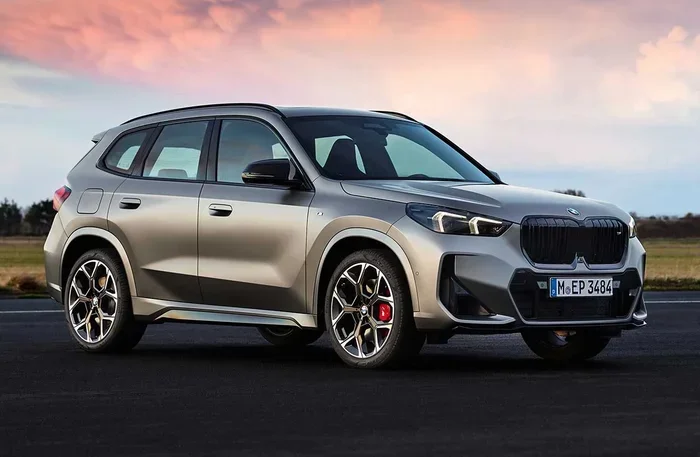
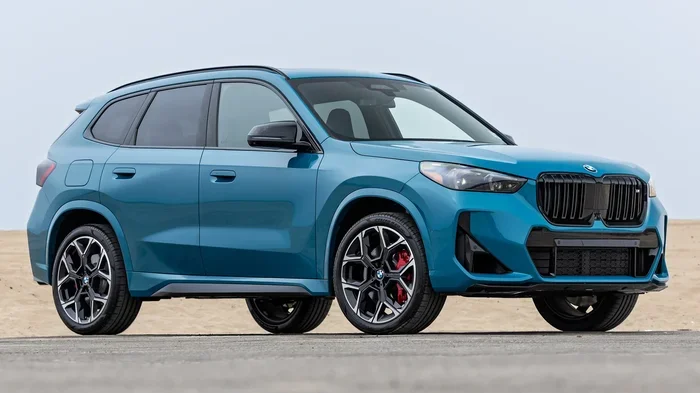
- M35i (2020+ LCI): B48 High Output + Mild Hybrid (~302 hp / 312 hp). M Performance model. Distinct quad exhaust, blue brake calipers, M diff.
- xDrive25e / xDrive30e: Plug-in Hybrid (B38 1.5L 3-cyl + Electric Motor). ~220-245 hp combined. Charge port on front fender.
U11 Generation Badges (US Market)
- xDrive23i: B48 2.0L Mild Hybrid (~215 hp). Base model.
- xDrive28i: B48 2.0L Mild Hybrid (~241 hp). Mid model.
- M35i xDrive: B48 High Output Mild Hybrid (~312 hp). Top gas model.
- iX1 xDrive30: Electric. Dual Motor. ~313 hp. No engine badge, just “iX1”.
The M Sport Package Difference
Many owners confuse “M Sport” with an “M Model” (like M35i). They are different.
- M Sport Package (ZMP / 7MH): An appearance and handling package available on any trim (even 18i/20i). Includes: Aerodynamic bumpers (wider lower grilles), Shadowline exterior trim (black window surrounds), M Sport suspension (lowered ~10-15mm, stiffer), M Sport steering wheel (thick rim, colored stitching), M badges on steering wheel and door sills, specific wheel designs (usually 18″ or 19″), Anthracite headliner.
- M Performance Model (M35i): A distinct model tier. Includes M Sport package PLUS: Specific high-output engine tune, M Sport Differential (mechanical limited-slip on F48/U11), M Sport Brakes (larger, often blue/red calipers), M Exhaust (quad tips, sound tuning), specific M-only wheels, unique interior trim (aluminum mesh/carbon fiber), M badges on front fenders.
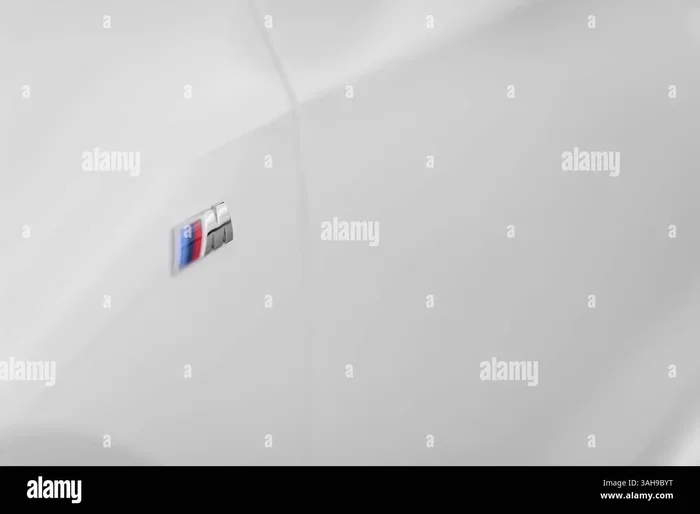
How to tell: Look at the front fenders. If there is an “M” badge on the front fender (behind the wheel arch), it is a genuine M35i. If the only M badges are on the steering wheel, door sills, and maybe the shift knob, it is an M Sport package on a lesser model. Check the VIN decoder for option code 7MH (M Sport Package) vs Sales Designation M35i.
Using BMW Option Codes and Build Sheets
The VIN decoder gives you a list of “Option Codes” (also called SA Codes, PR Codes, or Equipment Codes). These are 3-character alphanumeric codes (e.g., S02A, 2TB, 4UR). They tell you exactly what equipment your car left the factory with. This is the deep-dive answer to how can I tell what kind of X1 I have.
Finding Your Option Codes
- Door Jamb Sticker: Open driver’s door. Look at the white sticker on the B-pillar. There is a section labeled “Options” or “SA”. It lists 20-40 codes.
- Trunk Sticker: Lift the trunk floor cover (where the spare tire kit or repair kit sits). Often a sticker on the lid or body metal lists codes.
- VIN Decoder Report: The “Equipment” or “Options” tab on RealOEM or bmwvin.com.
- iDrive Menu (F48/U11): Settings > Vehicle Information > Vehicle Data > Option Codes (sometimes hidden in service menu).
Decoding Common Option Codes
There are hundreds of codes. Here are the high-value ones for X1 identification:
| Code | Meaning | Why It Matters |
|---|---|---|
| 7MH | M Sport Package | Confirms aero kit, suspension, steering wheel, seats. |
| 2TB | 8-Speed Sport Automatic | Paddles, faster shifts, launch control (on some). |
| 2VF | Adaptive M Suspension | Electronically controlled dampers (Comfort/Sport). |
| S02A | M Sport Differential | Mechanical LSD (Standard on M35i, opt on others). |
| 3AG | Rear View Camera | Essential for parking. |
| 5AS | Active Driving Assistant | Blind spot, lane departure, cross traffic. |
| 6WB | Multifunctional Instrument Cluster | Digital cluster (pre-LCI F48) or Live Cockpit. |
| 6U3 | BMW Live Cockpit Pro / Plus | Navigation, digital dash, screen size indicator. |
| 4UR | Ambient Lighting | Color-adjustable interior lights. |
| 494 | Heated Front Seats | Standard in cold states, optional elsewhere. |
| 4HA | Heated Steering Wheel | Often part of Cold Weather Package. |
| 3MC | Roof Rails (High Gloss Shadowline) | M Sport specific roof rails. |
| ZPP | Premium Package | Bundle: Nav, Heated Seats, Ambient Light, etc. |
| ZDA | Driving Assistance Package | Bundle: Adaptive Cruise, Steering Assist, etc. |
| ZPK | Parking Assistance Package | Surround View, Auto Park, Remote 3D View. |