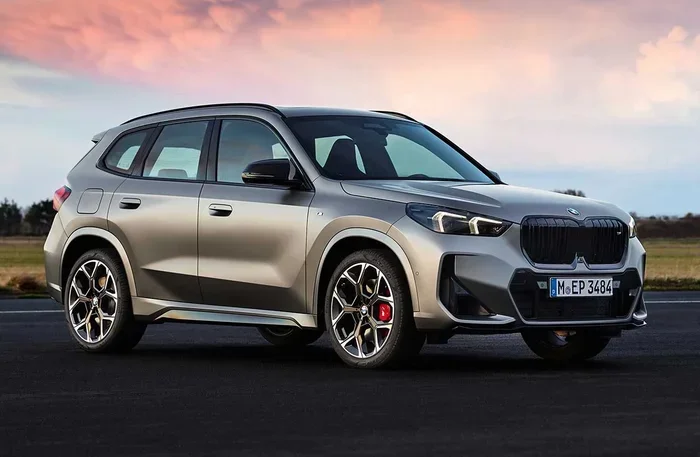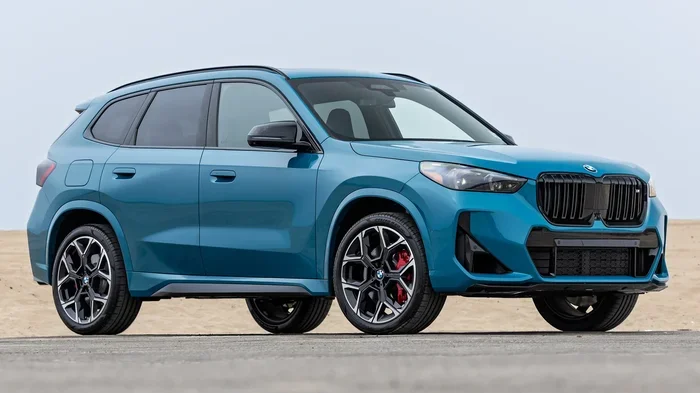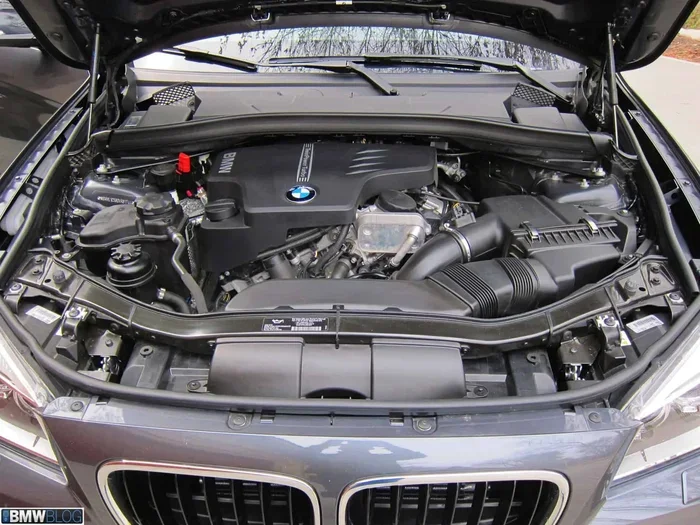
Featured image for BMW X1 engine bay
Image source: cdn.bmwblog.com
What engine is in a BMW X1 depends heavily on the model year and trim level. This guide breaks down every engine option from the first generation E84 to the current U11, covering turbocharged four-cylinders, diesel variants, and the new mild-hybrid systems. You will learn which engines offer the best balance of power and fuel economy, plus key maintenance tips to avoid costly repairs.
Shopping for a used BMW X1 or trying to decode the badge on your current ride? You are not alone. The question what engine is in a BMW X1 confuses many buyers because the answer changes drastically depending on the generation. Unlike the 3 Series, which keeps a similar engine philosophy for decades, the X1 has swapped platforms, drivetrain layouts, and engine families three times since 2009.
This guide covers every engine option for the US, Canadian, and European markets. We will look at horsepower, torque, known reliability quirks, and which years to target or avoid. Whether you want a frugal diesel commuter or the fire-breathing M35i, you will find the specs here.
Key Takeaways
- Three distinct generations: The BMW X1 has spanned three chassis codes (E84, F48, U11), each with completely different engine lineups.
- Four-cylinder dominance: Nearly every X1 sold globally uses a 2.0L turbocharged four-cylinder engine, either gas (B48/N20) or diesel (B47/N47).
- Naming convention logic: Badges like sDrive18i, xDrive23d, or M35i reveal the drivetrain, fuel type, and relative power output instantly.
- Timing chain concerns: Early N20 engines (2012-2015) have a known timing chain guide failure risk that buyers must verify.
- Mild-hybrid tech: The newest U11 generation uses 48-volt mild-hybrid systems on all gas engines for smoother start-stop and torque fill.
- Coolant is critical: Using the correct BMW-approved coolant prevents internal corrosion and protects the turbocharger.
- Transmission pairing matters: Older models use a ZF 8-speed torque converter, while newer F48/U11 models use a 7-speed dual-clutch (DCT) for transverse layouts.
📑 Table of Contents
- First Generation (E84): 2009–2015
- Second Generation (F48): 2015–2022
- Third Generation (U11): 2023–Present
- Gasoline vs Diesel: Which BMW X1 Engine Is Right for You?
- Decoding the Badge: What Do sDrive, xDrive, 18i, 23d Mean?
- Common BMW X1 Engine Problems & Reliability
- Maintenance Tips to Keep Your X1 Engine Running Strong
- Buying Guide: Best & Worst Model Years for Engines
- Performance Tuning Potential
- Frequently Asked Questions
- Conclusion
First Generation (E84): 2009–2015
The original E84 X1 was unique. It sat on a rear-wheel-drive platform (shared with the E90 3 Series). This meant longitudinal engine mounting. It offered a mix of naturally aspirated and early turbo engines.
Gasoline Engines (N52, N20)
The early years (2010–2011) used the legendary N52 3.0L inline-six. This engine is widely considered one of BMW’s best. It makes 258 hp in the xDrive28i. It has no turbo, no direct injection carbon buildup issues, and a proven track record.
- xDrive28i (2010–2011): N52 3.0L I6, 258 hp, 230 lb-ft.
- sDrive28i / xDrive28i (2012–2015): N20 2.0L Turbo I4, 240 hp, 260 lb-ft.
In 2012, BMW swapped the six-cylinder for the N20 2.0L turbo four-cylinder. Power stayed similar, but fuel economy improved. However, the N20 introduced a timing chain guide issue. Plastic guides become brittle and shatter, potentially destroying the engine. If buying a 2012–2015 model, demand proof the timing chain was updated to the revised part.
Diesel Engines (N47)
European and Canadian buyers got the N47 2.0L turbo diesel. It offered massive torque (up to 332 lb-ft in the 23d) and 40+ MPG. The N47 has its own timing chain problem, located at the rear of the engine (transmission side), making repairs very expensive.
- xDrive18d / 20d / 23d / 25d: Variants of the N47 2.0L Twin-Turbo I4 (143–218 hp).
Transmission & Drivetrain (E84)
All E84 models used a ZF 6-speed automatic (6HP) or the excellent ZF 8-speed (8HP) in later years. The xDrive system is a true planetary center differential with a 40:60 rear bias. It handles snow and light off-roading well.
Second Generation (F48): 2015–2022
The F48 marked a massive shift. BMW moved the X1 to the UKL front-wheel-drive platform (shared with the Mini Countryman and 2 Series Active Tourer). Engines are now mounted transversely. This freed up interior space but changed the driving feel.
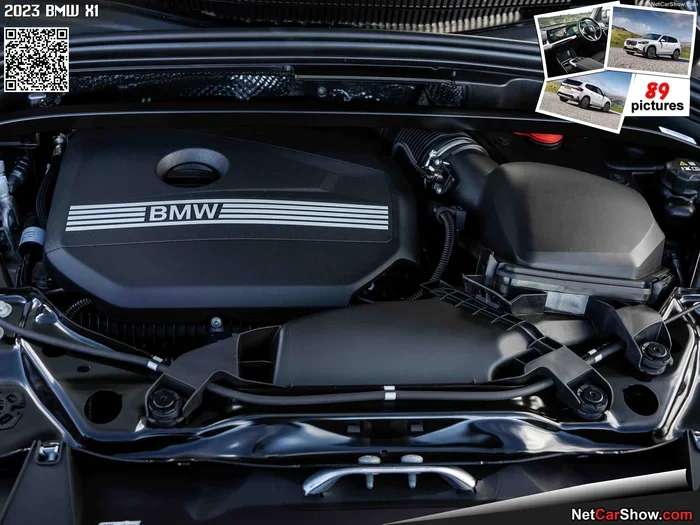
Visual guide about BMW X1 engine bay
Image source: netcarshow.com
Gasoline Engines (B38, B48)
BMW introduced the modular B-series engines. The B38 1.5L three-cylinder powers the base models. The B48 2.0L four-cylinder powers the volume sellers. Both are reliable, direct-injection turbos with Valvetronic.
- sDrive18i / xDrive18i: B38 1.5L Turbo I3, 136 hp, 162 lb-ft.
- sDrive20i / xDrive20i: B48 2.0L Turbo I4, 192 hp, 207 lb-ft.
- xDrive25i: B48 2.0L Turbo I4, 228 hp, 258 lb-ft.
US Market Note: The US only received the xDrive28i (B48, 228 hp) for most years. The sDrive (FWD) models arrived very late in the lifecycle (2022) as the sDrive28i.
Diesel Engines (B47)
The B47 2.0L four-cylinder diesel replaced the N47. It moved the timing chain to the front (accessible side), solving the major N47 headache. It is smooth, punchy, and efficient.
- xDrive18d / 20d / 23d / 25d: B47 2.0L Turbo I4 (150–231 hp).
Plug-in Hybrid (F48 PHEV)
Launched in 2020, the xDrive25e combines a B38 1.5L three-cylinder gas engine with an electric motor. Total system output is 220 hp. It offers ~35 miles of EV range (WLTP). It uses a 6-speed automatic (not DCT) to handle the hybrid integration.
Transmission & Drivetrain (F48)
- FWD (sDrive): 7-speed Dual Clutch Transmission (DCT).
- AWD (xDrive): 7-speed DCT (early) or 8-speed Torque Converter (later/higher torque).
The xDrive system here is an electro-hydraulic clutch pack (Hang-on clutch). It sends power to the rear only when slip is detected. It is lighter and cheaper but less proactive than the E84 system.
Third Generation (U11): 2023–Present
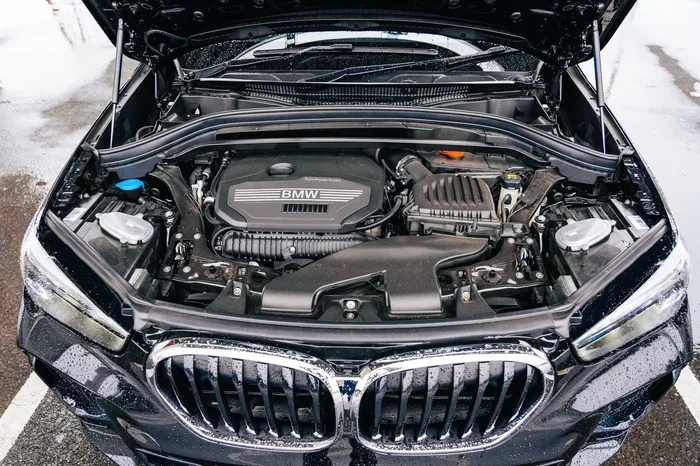
The current U11 stays on the UKL platform (FAAR architecture) but gets a major tech overhaul. Every gasoline engine is now a 48-volt mild hybrid (MHEV). A starter-generator motor adds 18 hp and 147 lb-ft of instant torque assist.
Visual guide about BMW X1 engine bay
Image source: images.carexpert.com.au
Gasoline Mild-Hybrid Engines (B38, B48 MHEV)
- sDrive18i / xDrive18i: B38 1.5L Turbo I3 MHEV, 136 hp + 18 hp electric.
- xDrive20i / xDrive23i: B48 2.0L Turbo I4 MHEV, 170 hp / 218 hp + 18 hp electric.
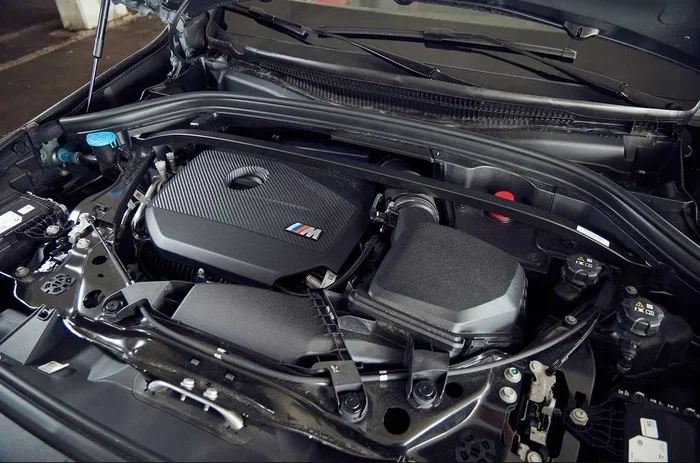
- M35i xDrive: B48 2.0L Turbo I4 MHEV, 312 hp, 295 lb-ft. (US Spec).
The M35i is the star. It uses a higher-boost B48, specific tuning, a mechanical limited-slip differential (front), and standard adaptive suspension. It hits 60 mph in ~4.9 seconds.
Diesel Mild-Hybrid (B47 MHEV)
- xDrive18d / 20d / 23d: B47 2.0L Turbo I4 MHEV, 150–211 hp + electric assist.
The diesel MHEV system allows the engine to shut off earlier during coasting (sailing) and restarts instantly. It smooths out the diesel clatter at idle.
Electric: iX1 (U11 BEV)
Technically an X1 variant, the iX1 xDrive30 uses dual motors (one per axle) for 313 hp and standard AWD. It has a 64.7 kWh usable battery for ~270 miles WLTP range. No gas engine here, but worth knowing it shares the chassis.
Gasoline vs Diesel: Which BMW X1 Engine Is Right for You?
Choosing between gas and diesel depends entirely on your driving profile. Here is a quick comparison for the F48/U11 generations where both are widely available.
Visual guide about BMW X1 engine bay
Image source: insidethehood.com
| Factor | Gasoline (B48/B38) | Diesel (B47) |
|---|---|---|
| Low-End Torque | Good (peaks ~1,450 rpm) | Excellent (peaks ~1,750 rpm, higher peak) |
| Fuel Economy (Combined) | 26–32 MPG (Real world) | 40–50 MPG (Real world) |
| Refinement | Quieter, smoother revving | More vibration, audible clatter when cold |
| Maintenance Cost | Lower (standard oil, spark plugs) | Higher (DPF, AdBlue, larger oil capacity) |
| Short Trips / City | Better (No DPF regen issues) | Risky (DPF clogs without highway runs) |
| Towing Capacity | Up to 3,500 lbs (M35i higher) | Up to 4,000+ lbs (Torque advantage) |
Verdict: Buy gasoline if you do mostly city driving, short trips, or keep cars 100k+ miles. Buy diesel if you rack up 15k+ highway miles per year and tow regularly. The B47 diesel is excellent, but the DPF filter and AdBlue system add failure points as mileage climbs.
Decoding the Badge: What Do sDrive, xDrive, 18i, 23d Mean?
BMW badges look like alphabet soup, but they follow a strict code. Cracking the code tells you the engine in a BMW X1 instantly.
The Formula: [Drivetrain][Output][Fuel]
- Drivetrain: sDrive = FWD (or RWD on old E84). xDrive = AWD.
- Output (Two Digits): Roughly correlates to performance tier, not literal displacement.
- 18 = Entry (1.5L Gas or Low-Power Diesel).
- 20 = Mid (2.0L Gas Standard or Mid Diesel).
- 23 / 25 / 28 = High Output (2.0L Gas High or High Diesel).
- 35 = M Performance (M35i).
- Fuel Suffix: i = Gasoline. d = Diesel. e = Plug-in Hybrid.
Examples
- xDrive28i: AWD + High Output 2.0L Gas (E84 N20 / F48 B48).
- sDrive18d: FWD + Entry 2.0L Diesel.
- xDrive25e: AWD + Plug-in Hybrid (1.5L Gas + Electric).
- M35i xDrive: M Performance + AWD + Highest Output 2.0L Gas.
Common BMW X1 Engine Problems & Reliability
No engine is perfect. Knowing the weak spots helps you buy smart or maintain proactively.
1. N20 Timing Chain (E84 2012–2015)
This is the #1 dealbreaker for early FWD-switch models. The plastic chain guide rails disintegrate. Symptoms: Cold start rattle, check engine light (camshaft correlation codes).
Fix: Updated tensioner and metal-backed guides. Cost: $1,500–$3,000 DIY vs Shop. Verify service records before buying.
2. N47 / B47 Timing Chain (Diesel)
N47 (E84): Chain at rear. Engine-out job. Very expensive.
B47 (F48/U11): Chain at front. Much easier. Still, inspect at 80k miles. Listen for metallic rattle on cold start.
3. Valve Cover & Oil Filter Housing Gaskets (N20 / B48)
The N20 valve cover integrates the PCV valve. The diaphragm tears, causing rough idle and smoke. The oil filter housing gasket (OFHG) leaks onto the serpentine belt, risking belt ingestion into the crank seal.
Tip: Replace OFHG gasket every 60k miles as cheap insurance.
4. Coolant Leaks & Thermostat (All Generations)
BMW cooling systems are pressurized and plastic-heavy. The thermostat housing, water pump (electric on newer), and expansion tank crack with age.
Critical: Never top off with plain water or generic green coolant. You must use BMW-approved HT-12 coolant (blue/green) to protect aluminum blocks and the turbo bearing. Mixing coolant types creates sludge that kills water pumps. For help picking the right fluid, see our guide on choosing the right coolant for your BMW vehicle.
5. Carbon Buildup (Direct Injection)
All turbo gas engines (N20, B48) are direct injection. Intake valves get no fuel wash. By 60k–80k miles, carbon restricts airflow. Symptoms: Cold misfires, power loss, rough idle.
Fix: Walnut blasting ($400–$800). Prevent with occasional high-RPM Italian tune-ups and quality Top Tier gas.
6. Drivetrain Malfunction Warning
This scary iDrive message (“Drivetrain Malfunction. Drive Moderately.”) puts the car in limp mode. On the X1, it is often caused by:
- Boost leaks (cracked charge pipe / intercooler).
- High-pressure fuel pump (HPFP) failure (N20/B48).
- VANOS solenoid failure.
- Transmission mechatronic sleeve leak (F48 DCT).
If this appears, scan codes immediately. Do not ignore it. For a deep dive on this specific error, read our article on the proven BMW drivetrain malfunction meaning.
Maintenance Tips to Keep Your X1 Engine Running Strong
BMWs reward preventive maintenance. Skip it, and they punish your wallet. Follow this schedule for any X1 engine.
Oil Changes: The 7,500-Mile Rule
Ignore the 10k–15k mile Condition Based Service (CBS) interval. Turbo engines dilute oil with fuel. Change synthetic oil (LL-01 or LL-17FE+ spec) every 7,500 miles or 12 months. Use a quality filter (Mann, Mahle, OEM).
Spark Plugs & Ignition Coils
- N20/B48: Replace plugs every 45k–60k miles. Coils fail around 70k–90k miles. Replace all 4 coils if one fails.
- B38 (3-cyl): Same interval, cheaper (3 plugs/coils).
Walnut Blasting (Gas Direct Injection)
Schedule intake valve cleaning every 60k–80k miles. It restores lost power and fuel economy. It is cheaper than fixing a misfire that damages a catalytic converter.
Transmission Fluid (The “Lifetime” Myth)
ZF 8HP (E84 xDrive, some F48 xDrive): Change fluid and filter at 80k miles.
DCT 7-Speed (F48 sDrive, xDrive 4-cyl): Change fluid at 60k miles. DCT fluid degrades fast from clutch wear debris.
Transfer Case & Rear Diff (xDrive Models)
E84: Transfer case fluid (TL3) and rear diff fluid (75W-90) every 60k miles.
F48/U11: The power take-off unit (PTU) on the transmission side and rear clutch pack need fluid changes every 60k miles. Neglecting this kills the AWD clutch pack ($2,000+ repair).
Coolant Flush
Flush and fill with distilled water + BMW HT-12 concentrate (50/50) every 4 years or 60k miles. Bleed the system properly (electronic bleed procedure via scanner or pedal method) to avoid air pockets in the turbo coolant lines.
Buying Guide: Best & Worst Model Years for Engines
Best Used Buys
- 2011 E84 xDrive28i (N52): Bulletproof inline-6. No turbo, no timing chain fear. Slowest 0-60, but most reliable.
- 2017–2019 F48 xDrive28i (B48): Early B48 bugs worked out. ZF 8-speed auto (best transmission). Proven reliability.
- 2021–2022 F48 xDrive23d (B47 MHEV): Updated diesel with mild hybrid. Best torque/fuel economy combo.
- 2024+ U11 M35i: If buying new/nearly new. Peak performance, mechanical LSD, best chassis tuning.
Years to Approach With Caution
- 2012–2015 E84 xDrive28i (N20): High timing chain risk. Only buy if chain service documented recently.
- 2016 F48 Launch Year: Early DCT software glitches, teething issues with B48 integration.
- 2020–2021 F48 xDrive25e PHEV: Complex hybrid system. Battery coolant leaks reported. High repair cost out of warranty.
Performance Tuning Potential
The B48 engine (F48/U11 20i/28i/M35i) responds incredibly well to tuning.
- Stage 1 Tune (Software only): +40–60 hp / +50–70 lb-ft. Safe on stock hardware with 93 octane. Makes a 28i feel like an M35i.
- Stage 2 (Downpipe + Intake + Tune): +80+ hp. Requires catless or high-flow catted downpipe. Check local emissions laws.
- M35i: Already tuned high. Stage 1 pushes ~360 hp. Risk of clutch slip on DCT/8HP if torque limiters not raised correctly.
Warning: Tunes void powertrain warranty. BMW can detect flash counters (TD1 flag). Weigh the risk.
Frequently Asked Questions
Does the BMW X1 have a 4-cylinder or 6-cylinder engine?
Almost all BMW X1 models use a 4-cylinder engine. The only exception is the first-generation E84 (2010–2011 xDrive28i), which used the N52 3.0L inline-6. Every model since 2012 uses a 2.0L turbo-4 (gas or diesel) or a 1.5L turbo-3 (base gas models).
What engine is in the BMW X1 M35i?
The BMW X1 M35i (U11 generation, 2023+) uses a high-output version of the B48 2.0L turbocharged inline-4 with a 48-volt mild-hybrid system. It produces 312 hp and 295 lb-ft of torque in US spec, paired with a 7-speed dual-clutch transmission and standard xDrive with a front mechanical limited-slip differential.
Is the BMW X1 engine reliable?
Reliability varies by generation. The E84 N52 (2010–2011) and F48/U11 B48/B47 (2016+) are generally very reliable. The E84 N20 (2012–2015) has a known timing chain defect. The F48 B38 3-cylinder is reliable but can feel unrefined. Regular oil changes every 7,500 miles are the single biggest factor in longevity.
What is the difference between sDrive and xDrive on the X1?
sDrive means Front-Wheel Drive (FWD) on the F48 and U11 generations (RWD on the old E84). xDrive means All-Wheel Drive (AWD). On the F48/U11, xDrive uses a front-biased system that engages the rear axle electronically via a clutch pack when slip is detected. It is not a full-time 50/50 split like older BMWs.
Can I put regular gas in a BMW X1?
BMW recommends 91+ octane (Premium) for all turbocharged gasoline engines (N20, B48, B38). The engine computer will retard timing to prevent knock on 87 octane, reducing power and potentially hurting fuel economy. You can run regular in an emergency, but avoid wide-open throttle. For the M35i, premium is mandatory.
How often should I change the oil in my BMW X1?
Do not follow the 10,000–15,000 mile dashboard reminder. Change the oil every 7,500 miles or once a year, whichever comes first. Turbocharged direct-injection engines dilute oil with fuel faster. Frequent changes protect the turbo bearings, timing chain, and VANOS system. Use LL-01 or LL-17FE+ approved 0W-20 or 0W-30 synthetic.
Conclusion
So, what engine is in a BMW X1? The answer is a moving target. You have the legendary N52 inline-six in the very first years, the problematic but peppy N20 after that, and the solid B-series modular engines (B38, B48, B47) from 2016 onward. The newest U11 generation adds mild-hybrid assist to every gas and diesel variant.
If you prioritize reliability above all, hunt for a 2011 E84 with the N52 or a 2018+ F48 with the B48. If you want modern tech and efficiency, the U11 mild-hybrids are impressive. If you need torque for towing, the B47 diesel is king—provided you drive enough highway miles to keep the DPF happy.
Regardless of which engine sits under your hood, the secret to a long life is simple: change your oil early, use correct BMW coolant, and scan for codes the moment a light appears. Treat the maintenance schedule as gospel, not a suggestion, and your X1 will deliver the “Ultimate Driving Machine” experience for hundreds of thousands of miles.